Research Projects
2D materials are ultrathin crystalline nanomaterials which have gained considerable interest for sensing and electronic applications. Graphene, an atomically thin zero-gap semiconductor, first isolated and characterized in 2004 was the first and most commonly studied 2D material. Over the last decade other 2D semiconductors which have sizeable band bandgaps and tuneable band structure, such as such as MoS2, MoSe2, 2D-tellurium, have gained increasing attention for new applications such as sensing and electronics. Our focus is the development and fabrication of sensors and devices for fluid biomarker detection and gas/volatile organic compound detection for diagnostic and treatment monitoring applications.
1) Fluid Biomarker Sensors
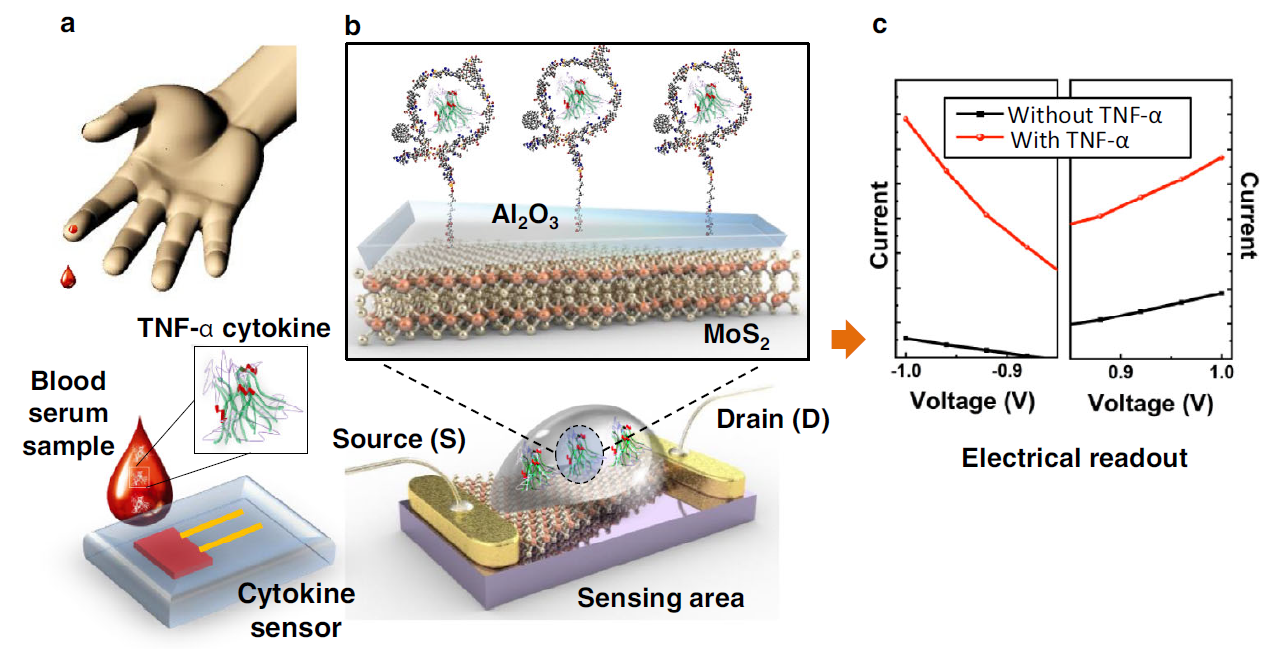
Biomarkers are measurable indicators that help determine if a person may have or be at risk of developing a disease. They can also help monitor or predict the effectiveness of treatments and help identify suitable patients for clinical trials of new treatments. This project leverages the unique properties of 2D semiconductors, including high surface-to-volume ratio, band structure tunability using surface effects, and high mobility, to detect fluid biomarker proteins at femtomolar concentrations from small volume samples. We are collaborators with colleagues in Physics and Health Sciences and industry to develop an easy-to-use, rapid, and minimally invasive method to detect fluid biomarkers of Alzheimer’s disease.
2) Gas and Volatile Organic Compound Sensors
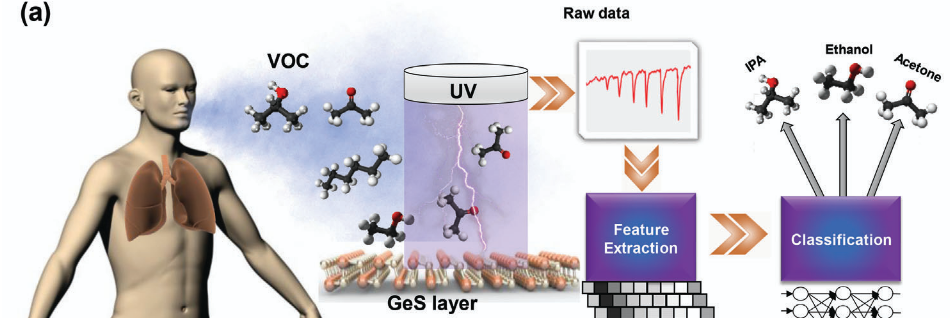
Biomarkers are measurable indicators that help determine if a person may have or be at risk of developing a disease. They can also help monitor or predict the effectiveness of treatments and help identify suitable patients for clinical trials of new treatments. This project leverages the unique properties of 2D semiconductors, including high surface-to-volume ratio, band structure tunability using surface effects, and high mobility, to detect fluid biomarker proteins at femtomolar concentrations from small volume samples. The objective of this multi-disciplinary project is to develop an easy-to-use, rapid, and minimally invasive method to detect fluid biomarkers of Alzheimer’s disease and other neurological disorders.
3) New Electronic Device Architectures
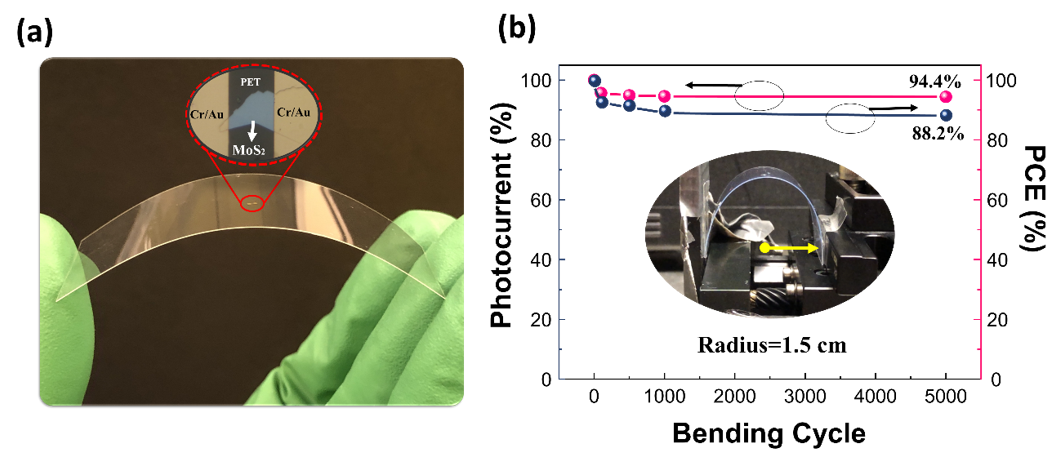
Traditional p-type and n-type doping of 2D semiconductor is challenging and resource demanding. We are investigating new methods to generate dioe rectification using Schottky barrier interfaces in 2D semiconductors without the need for doping such as asymmetric geometry, thickness modulated, and liquid-solid heterojunctions and study their mechanism of operation.